

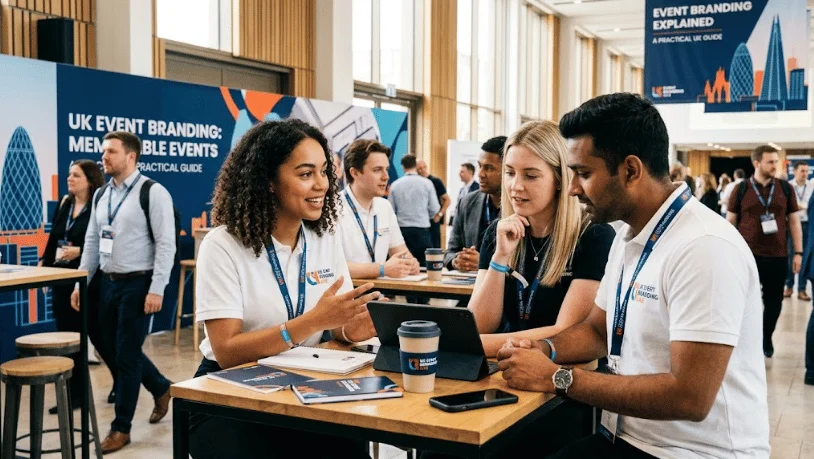
Event branding gives an event a clear identity across the spaces, materials, screens, and communications attendees encounter. Done well, it makes the experience easier to recognise and remember. It also helps sponsors, organisers, and messages appear connected rather than scattered.
Direct answer: Event branding is the planned use of visual identity, messaging, signage, digital graphics, spaces, and attendee materials across an event. A strong approach keeps every touchpoint consistent, helps visitors navigate the venue, supports sponsors, creates better photo opportunities, and makes the experience feel connected from registration to follow-up.
| Key area | What it covers | Why it matters |
|---|---|---|
| Visual identity | Colours, type, graphics, event logo | Creates recognition |
| Venue graphics | Banners, walls, stages, signs | Makes physical spaces feel connected |
| Wayfinding | Directional and information signs | Reduces visitor confusion |
| Digital assets | Screens, slides, emails, social graphics | Extends the identity beyond the venue |
| Attendee materials | Badges, programmes, lanyards, merchandise | Adds useful branded touchpoints |
| Sponsor visibility | Logos, zones, screens, displays | Gives partners planned exposure |
| Content moments | Backdrops, installations, photo areas | Encourages organic sharing |
| Measurement | Leads, scans, mentions, surveys | Shows whether the investment worked |
Key Takeaways
* Start with the event purpose and audience before choosing graphics. * Use one visual system across physical and digital touchpoints. * Prioritise entrances, stages, wayfinding, and high-traffic areas. * Design branded spaces that still serve a useful purpose. * Plan sponsor visibility early instead of adding logos at the end. * Test important graphics at their real viewing distance. * Measure actions and outcomes rather than counting branded items.
Why Event Branding Matters
People rarely experience an event through a single poster or stage screen. They meet the identity through emails, signs, badges, displays, presentations, staff, and social content. Repetition across those touchpoints makes the organiser easier to recognise.
Consistency also helps an event feel deliberately produced rather than assembled from unrelated suppliers. That matters at conferences, launches, exhibitions, festivals, awards, and corporate gatherings. A coherent identity can support trust before attendees hear the first presentation.
Strong physical moments can also create marketing material after the event ends. Magzonia’s review of recent innovative marketing examples shows how physical experiences can encourage voluntary sharing. That principle works for much smaller UK events too.
What Should You Brand at an Event?
Not every surface needs a logo. The strongest choices usually combine visibility, usefulness, and relevance to the attendee journey. Start with locations people must notice or use.
Entrances deserve attention because they confirm that guests have reached the right place. Registration points should continue the same visual system and communicate instructions clearly. Main stages then carry that identity into photographs, presentations, and recorded content.
Wayfinding deserves equal attention because poor navigation quickly damages the experience. Directional signs should favour readability before decoration. Visitors should understand where to go within seconds.
Digital touchpoints should match the physical environment rather than becoming a separate creative project. This includes registration emails, event apps, presentation slides, holding screens, and social graphics. Use the same colours, typography, language, and graphic treatments to connect them.
Useful branded materials can include the following.
* Registration desks and entrance graphics * Stage backdrops and lectern graphics * Directional and room signage * Digital screens and presentation templates * Name badges and lanyards * Programmes and printed schedules * Exhibition stands and sponsor areas * Table graphics and menus * Photo walls and content areas * Reusable flags, banners, and display systems
Event Branding Planning: A Simple UK Framework
Begin by defining what the event needs to achieve. A product launch may focus on media coverage and content creation. A trade exhibition may care more about enquiries, meetings, and stand traffic.
Next, map the attendee journey from invitation through departure. List what guests see before arriving, during registration, inside key rooms, and after leaving. This prevents important touchpoints from being discovered during installation.
Then rank each location by business value and visibility. Entrances, stages, networking spaces, exhibition zones, and photography areas often deserve priority. Secondary corridors usually need less creative investment unless navigation depends on them.
Create one practical design system before producing individual assets. Specify colours, typefaces, image treatments, logo rules, sponsor rules, and basic layouts. This makes production faster and reduces inconsistent supplier interpretations.
Finally, build a production schedule backwards from the event date. Include artwork approval, proofing, manufacturing, transport, installation, testing, and de-rigging. Venue access times should be confirmed before final production decisions.
How Much Does Event Branding Cost in the UK?
There is no standard UK price because event scope varies sharply. A few portable graphics cost far less than a conference requiring custom fabrication and installation. Venue access, materials, size, design work, and turnaround also affect the quote.
Current UK suppliers illustrate that spread clearly. Hyper Creative publishes example projects ranging from smaller print-and-install packages to large custom projects exceeding £18,000. Pearl Lemon Events lists event identity work separately from larger environmental, screen, collateral, and installation packages.
These published figures are useful reference points, not market-wide averages. Always compare quotes using the same scope, quantities, materials, installation requirements, and VAT treatment. A cheaper proposal may simply exclude important work.
| Cost driver | Usually lowers cost | Usually raises cost |
|---|---|---|
| Design | Existing approved artwork | New identity and asset creation |
| Materials | Standard reusable systems | Custom fabrication |
| Quantity | Few priority locations | Whole-venue coverage |
| Installation | Client-installed portable items | Specialist installation crew |
| Lead time | Planned several weeks ahead | Rush production |
| Venue | Simple ground-floor access | Restricted access or short build windows |
| Use period | Reusable graphics | One-off bespoke pieces |
Treat the budget as part of your wider acquisition plan when the event exists to generate business. Magzonia’s guide to customer acquisition channels and costs provides useful context for comparing events with digital channels. That comparison helps you judge whether the event investment supports a commercial goal.
Design for Recognition, Not Decoration
A visually busy venue is not automatically a strongly branded venue. Recognition depends on repeating a small number of distinctive visual and verbal cues. Those cues should remain recognisable from the entrance to the presentation screens.
Scale matters as much as design quality. Artwork that looks clear on a laptop can become unreadable across an exhibition hall. Important messages need enough contrast, size, and empty space for their viewing distance.
Photography should influence decisions without controlling every decision. Stages, entrances, networking zones, and installations often appear in social posts or press photographs. Place essential identity elements where cameras can capture them naturally.
Avoid filling every empty surface; too many graphics can make important information harder to find. Give wayfinding and safety information enough visual separation. Branding should support the event experience, not compete with it.
Give Sponsors a Planned System
Sponsor visibility often becomes messy when it is handled late. Organisers may add logos to every available surface without considering hierarchy. That approach can weaken both the organiser and sponsor identities.
Create sponsorship levels before final artwork begins. Define which placements belong to headline partners, supporting partners, exhibitors, and other contributors. The rules should cover size, frequency, placement, and digital exposure.
Sponsors may value useful visibility more than repeated logo walls. Session introductions, networking spaces, charging areas, demonstrations, and relevant content can create stronger associations. The right choice depends on the audience and sponsorship agreement.
Make the Event Easy to Share

Branded content works better when people have a reason to photograph it. A logo alone rarely does. An interesting installation, useful demonstration, distinctive set, or participatory moment can do more.
Think about framing and lighting before building a photo area. Guests need enough space to stand comfortably without blocking circulation. Brand elements should remain visible in a vertical phone photo.
This approach links physical activity to broader marketing. It can also reduce dependence on paid distribution when attendees create useful content themselves. Magzonia’s guide to content pillars can help organise that post-event material into broader campaigns.
Common Mistakes to Avoid
One common mistake is starting with products instead of objectives. Ordering banners, flags, and walls before planning the visitor journey creates unnecessary expense. Decide what each item needs to accomplish before choosing its format.
Another mistake is treating readability as a minor design concern. Small type and low contrast become serious problems in crowded venues. Always review priority graphics at realistic sizes and distances.
Late sponsor changes can also create production problems. New logos may affect layouts, print deadlines, and digital files across several suppliers. Set an approval deadline and explain what happens after that date.
Single-use thinking can increase costs unnecessarily. Modular frames, neutral structures, and replaceable graphic panels may suit recurring events. Reuse should still make sense for the event format and visual identity.
How Do You Measure Success?
Start measuring before production because the objective determines what you track. An exhibition may measure qualified conversations and scans. A launch may focus on coverage, content, demonstrations, or product interest.
Useful measures include the following.
* Registration and attendance rates * Stand or zone visits * Badge scans and qualified leads * QR code interactions * Demonstration participation * Social mentions and tagged content * Sponsor feedback * Attendee survey responses * Post-event enquiries * Sales linked to event contacts
Avoid claiming success because photographs looked polished. Compare results with the objective set before the event. Strong creative work matters most when it contributes to a useful attendee or business outcome.
Build a Better Branded Event
Start with the experience you want attendees to have, then decide which visual touchpoints support it. Give priority to high-value spaces and information people genuinely need. Fewer coordinated assets can outperform a venue filled with disconnected graphics.
Create the design system before production and involve suppliers early. Confirm venue restrictions, installation windows, artwork deadlines, and sponsor approvals in writing. These checks reduce last-minute changes and expensive reprints.
After the event, review what visitors noticed and what they ignored. Keep reusable assets that performed well and change weak elements before the next booking. That process turns each event into evidence for the next one.
Frequently Asked Questions
What is event branding?
Event branding is the coordinated identity used across an event’s physical and digital touchpoints. It can include signage, stage graphics, screens, badges, merchandise, wayfinding, and online communications. The goal is to create a recognisable, connected experience.
How early should you plan a branded event?
Start planning as soon as the venue, audience, and main objectives are clear. Larger installations need additional time for design, proofing, manufacturing, transport, and installation. Venue restrictions can also affect production choices.
What are the most important things to brand?
Entrances, registration areas, stages, wayfinding, and high-traffic spaces usually deserve priority. These areas combine visibility with practical value for attendees. Digital screens and presentation templates should follow the same visual system.
Can event graphics be reused?
Many formats can be reused when they are designed for repeated events. Modular frames, flags, fabric graphics, and replaceable panels can reduce future production needs. Date-specific or sponsor-specific elements may still need to be replaced.
How should a small business approach event design?
Start with a few high-impact locations instead of covering the entire venue. Keep the visual system simple, and make every item serve a clear purpose. Spend first on visibility, navigation, and areas where customer conversations happen.
How can you tell whether the branding worked?
Set measurable objectives before the event begins. Track leads, scans, attendance, interactions, social content, sponsor feedback, and, where relevant, post-event enquiries. Compare those results with your original goal rather than judging appearance alone.

